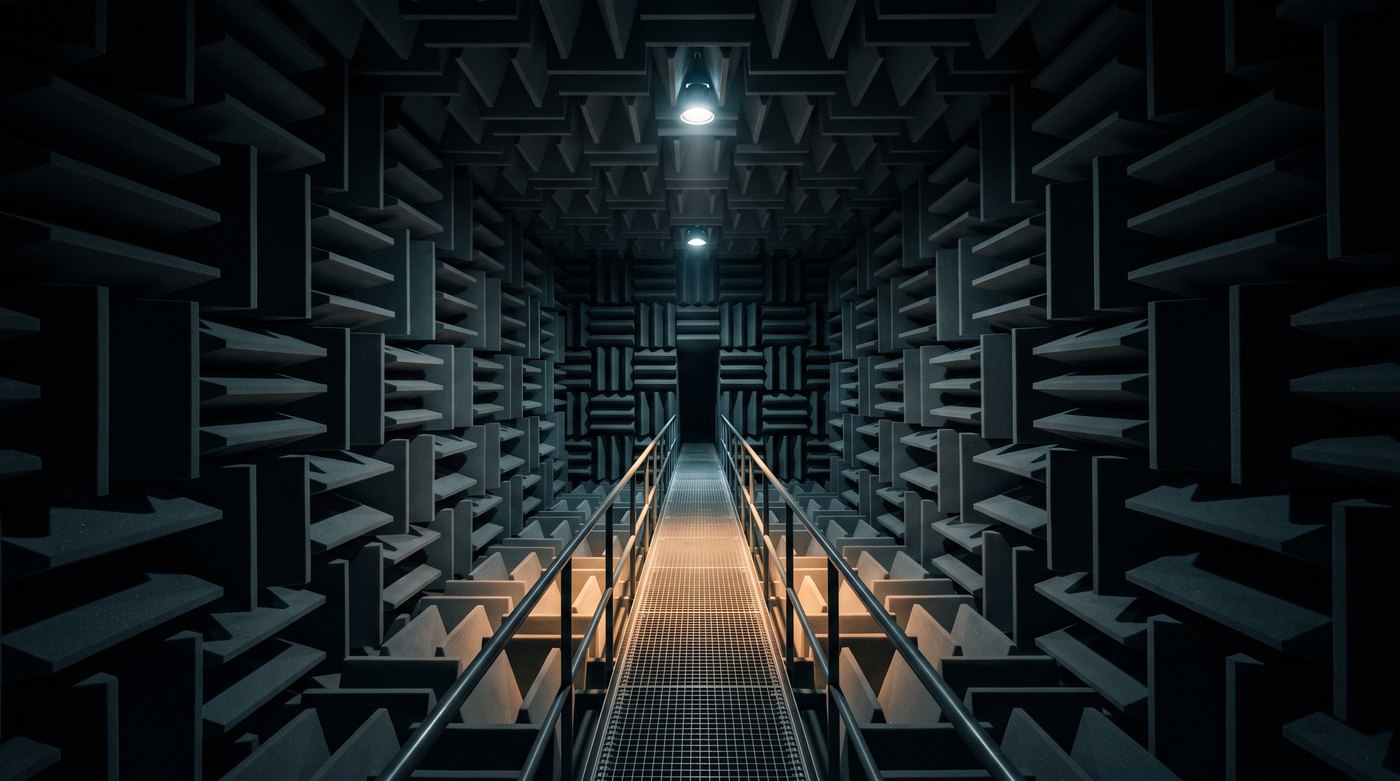
Interior of an anechoic acoustic testing chamber

the credibility document

How a paddle is measured.

Before we publish a single figure for our own paddles, here is exactly what we will measure, how, and under what conditions, so you can hold us to it.

01the physics

Two numbers describe a paddle's voice.

When a ball meets a face, the paddle rings like a struck plate. Everything you hear, and much of what you feel, reduces to two measurable quantities.

Frequency

The pitch of the impact, in hertz. It is set by the stiffness, mass and geometry of the face-and-core system: stiffer and lighter rings higher; softer and heavier rings lower. A higher frequency reads as a sharper, brighter crack; a lower one as a duller, rounder tap.

Frequency also carries: higher pitches cut through ambient noise and travel further past the fence line. It is the main reason paddle noise complaints exist.

what the player feels

Pitch is feedback. A consistent, known frequency means the paddle tells you the same thing about every strike. Mishits sound different from pure ones, and you learn faster.

Decay

How long the sound lasts, measured as the time the impact takes to fall to a defined fraction of its peak. A long decay is a ring-out: the paddle keeps vibrating after the ball has gone. A short decay is a clean stop.

Decay is decided mostly by damping: the core material, the bond layers, and the edge and throat construction. Two paddles at the same frequency can sound completely different if one rings twice as long.

what the player feels

Decay is the "buzz". Long decay is felt in the hand as lingering vibration; short decay feels settled and quiet. It also determines how intrusive a paddle is to everyone else.

02the reference range

The published landscape.

These figures are not ours. They are the industry-typical and published criteria the category is discussed against, and the scale our own results will be read on.

1,100–1,200 Hz Industry typical strike Where a typical paddle strikes. Bright, carrying, and the register most noise complaints describe. source: industry-typical range · not a BainPower measurement
≤600 Hz · ≤80 dBA Published quiet criteria At or below 600 hertz, and at or below 80 dBA. Roughly half the typical pitch. source: published quiet-equipment criteria · not a BainPower measurement
awaiting measurement BAM & TAP · all SKUs No BainPower paddle has been through a controlled acoustic cell yet. This card stays empty until one has. status: cell test pending · nothing estimated

Attribution matters. The two reference entries above describe the published landscape, not our products. We will never present a category figure as if it were a measurement of a BainPower paddle, in either direction.

03the protocol

What a proper test looks like.

Wedged foam interior of an anechoic chamber the anechoic cell, where the figure gets settled

A phone recording on a windy court is not a measurement. A defensible acoustic figure needs three things: a controlled room, a repeatable strike, and a calibrated ear.

ithe room

A controlled acoustic cell

Testing happens in an anechoic or acoustically controlled chamber, where reflections and background noise are removed or characterised. Outdoors, wind, echoes off fencing and neighbouring play contaminate every reading. In a cell, the only thing the microphone hears is the paddle.

iithe strike

A repeatable, instrumented strike

The paddle is excited the same way every time: a fixed impact energy at a fixed location on the face, using a mechanism rather than a human arm. Humans cannot swing identically twice; a rig can. Strike location matters too, because a paddle rings differently at its centre than at its edge, so the strike point is fixed and recorded.

iiithe ear

A calibrated microphone at a fixed distance

The microphone is a measurement-grade instrument, calibrated against a reference source before the session, placed at a fixed, documented distance and angle. Sound level falls with distance, so an uncontrolled mic position makes loudness figures meaningless. Calibration makes readings comparable between sessions, and between labs.

ivthe analysis

Analysis you can repeat

From each strike we extract the dominant frequency and the decay time: how long the signal takes to fall to a defined fraction of its peak. The analysis window, weighting and thresholds are documented, so anyone with the raw recordings can reproduce the numbers.

vthe sample

More than one paddle, more than one strike

A single unit tells you about that unit. We will test multiple production units per SKU with multiple strikes per unit, and publish the sample size alongside the result. A figure without a sample size is an anecdote with confidence.

04where we stand

We haven't run it yet.

Plainly: BainPower has not completed cell testing on any of its own SKUs. Not BAM, not TAP, not TAP Slim. Every acoustic field on this site is empty because the test has not been run, not because the result is being withheld.

We could have shipped this site with plausible numbers. Most of the category does. We publish the method first and the figures second, because a measurement you announce before you take it is the only kind you can't quietly revise.

·what we will publish, per SKU
cell test pending Dominant frequency In hertz, per SKU, from the controlled cell.
cell test pending Decay time Time from peak to a defined fraction, with the threshold stated.
with results Test conditions Chamber type, strike energy and location, mic model, distance and calibration.
with results Sample size Units tested and strikes per unit, published with every figure.

This page is the commitment. When cell testing is complete, the results will be published here: frequency, decay, conditions and sample size, for every SKU, whatever the numbers turn out to be. If a result is unflattering, it goes up anyway.

measured, then said.

The numbers land here first.

We will publish the cell-test figures here when they are done, and what they said.

Meanwhile, the paddles